
Force Multipliers with the Right Mission Partner
Artificial intelligence has quickly become one of the most discussed technologies in cybersecurity. New AI-enabled capabilities appear every week, promising to detect threats faster, automate investigations, and reduce repetitive work. Some deliver meaningful value. Others generate more hype than measurable results. Organizations that can distinguish between the two and apply AI with purpose stand to gain a lasting operational advantage.
Security teams are defending increasingly complex environments while managing evolving threats, expanding compliance requirements, and persistent workforce challenges. For organizations supporting national security missions, technologies that reduce administrative burden while improving mission readiness deserve careful consideration.
Like many other professions, some media outlets have speculated that AI may someday replace or reduce the need for cybersecurity professionals. However, in practice, its greatest value lies in strengthening what experienced practitioners already do well and freeing them from tedious, low-level tasks to enhance efficiency and increase bandwidth for thought work and problem-solving.
AI is most effective as a force multiplier.
It accelerates analysis, surfaces relevant information, and helps experienced teams spend more time making informed decisions.
That is the standard Markon applies to every AI-enabled capability: does it help experienced professionals operate faster and with greater confidence while maintaining accountability, security, and trust? If not, it is simply adding noise.
Decisions involving operational risk, contractual obligations, incident reporting, and Controlled Unclassified Information (CUI) still require human judgment. AI can accelerate the work, but experienced professionals remain responsible for the outcome.
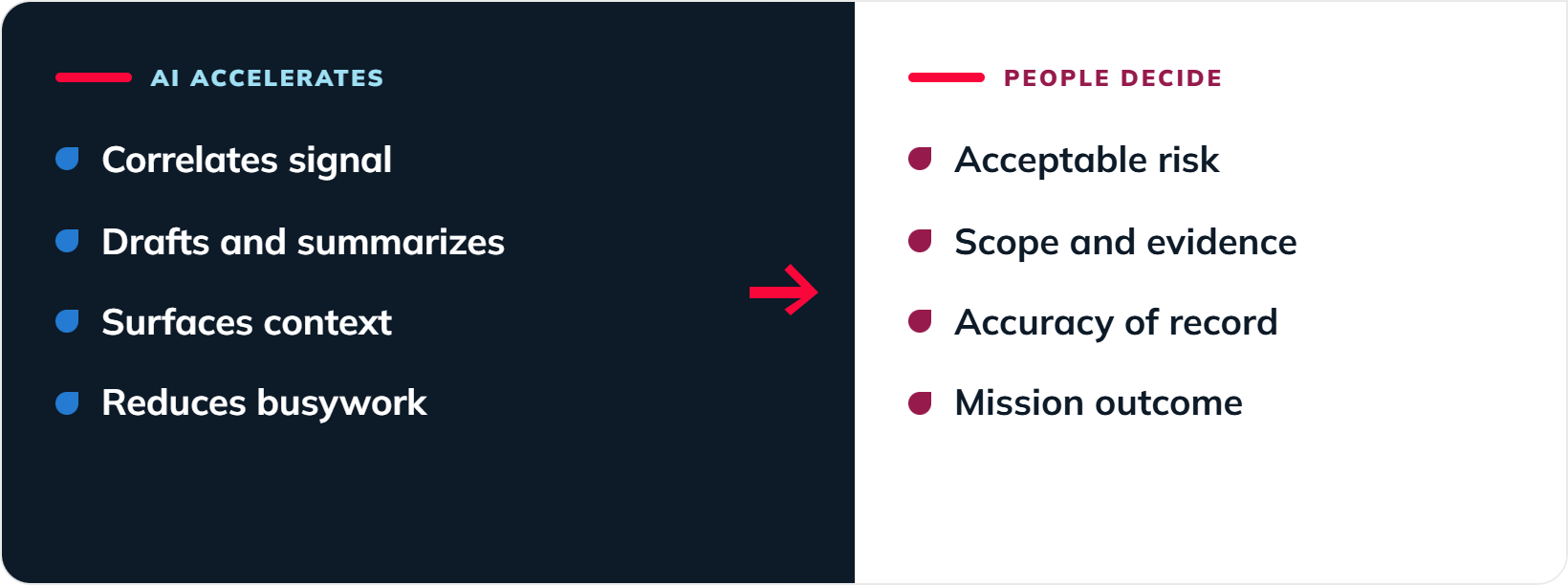
Here are five areas where AI is already helping cybersecurity teams become more effective.
1. Reducing Alert Fatigue
Modern security platforms generate enormous volumes of telemetry. AI helps correlate events across multiple sources, identify anomalous activity, and provide analysts with richer context before an investigation begins. Rather than deciding whether an incident occurred, AI helps analysts begin with better information so they can focus where experience and judgment create the greatest value.
2. Giving Incident Responders a Better Starting Point
AI can summarize logs, assemble preliminary timelines, identify common indicators, and draft incident narratives. These capabilities reduce administrative effort and accelerate investigations, but every output requires validation. Experienced responders remain responsible for determining scope, preserving evidence, and directing response activities.
3. Providing Better Context for Vulnerability Management
Prioritizing vulnerabilities requires understanding technical severity, operational importance, system exposure, maintenance constraints, and mission impact. AI can rapidly combine these factors and highlight where attention should be focused. The final decision still belongs to the professionals who understand the operational environment.
4. Making Compliance Documentation More Manageable
Policies, procedures, system security plans, and assessment artifacts require continual maintenance. AI can draft content, compare documentation, identify inconsistencies, and organize information. It cannot verify accuracy. Every document must reflect actual practices and be supported by evidence.
5. Helping Teams Share Knowledge
AI can summarize technical guidance, tailor information for different audiences, and reduce the effort required to communicate complex topics. Security professionals remain responsible for ensuring the information is accurate, complete, and appropriate for its audience.
You might also be interested in: Supercharging Acquisition Programs with AI-Enabled Mission Insight
Experience Matters
Like virtualization, cloud computing, and automation before it, AI is changing how cybersecurity professionals work rather than eliminating the need for their expertise. AI processes information at a remarkable speed. It does not understand an organization's mission, determine acceptable risk, or assume responsibility for consequential decisions. Similar to how most traditional cyber training programs are built to produce compliance rather than true capability, AI is great at managing tasks and situations similar to those it's seen or been trained on before, but nothing beats the fine-tuned problem-solving capability of true expertise in the face of continuously evolving novel threats in today's environment .
Organizations that create lasting advantage will not simply adopt AI first. They will pair AI with experienced mission practitioners, establish appropriate safeguards, validate outputs, protect sensitive information, and keep people at the center of consequential decisions.
Related: A Workforce Built for Yesterday
How Markon Puts This Into Practice
At Markon, AI is not an end in itself. It is one of many capabilities used to strengthen mission readiness, improve operational resilience, and help experienced teams make faster, better-informed decisions. Every AI-enabled capability is evaluated against a simple question: Does it help experienced professionals deliver greater mission impact while maintaining accountability, security, and trust?
Across our portfolio, AI is applied where it measurably improves performance while keeping people responsible for the decisions that matter most. That reflects our approach as a mission integrator: applying technology with discipline to advance client missions, not technology for its own sake.
AI-Enabled Capabilities That Strengthen Mission Performance
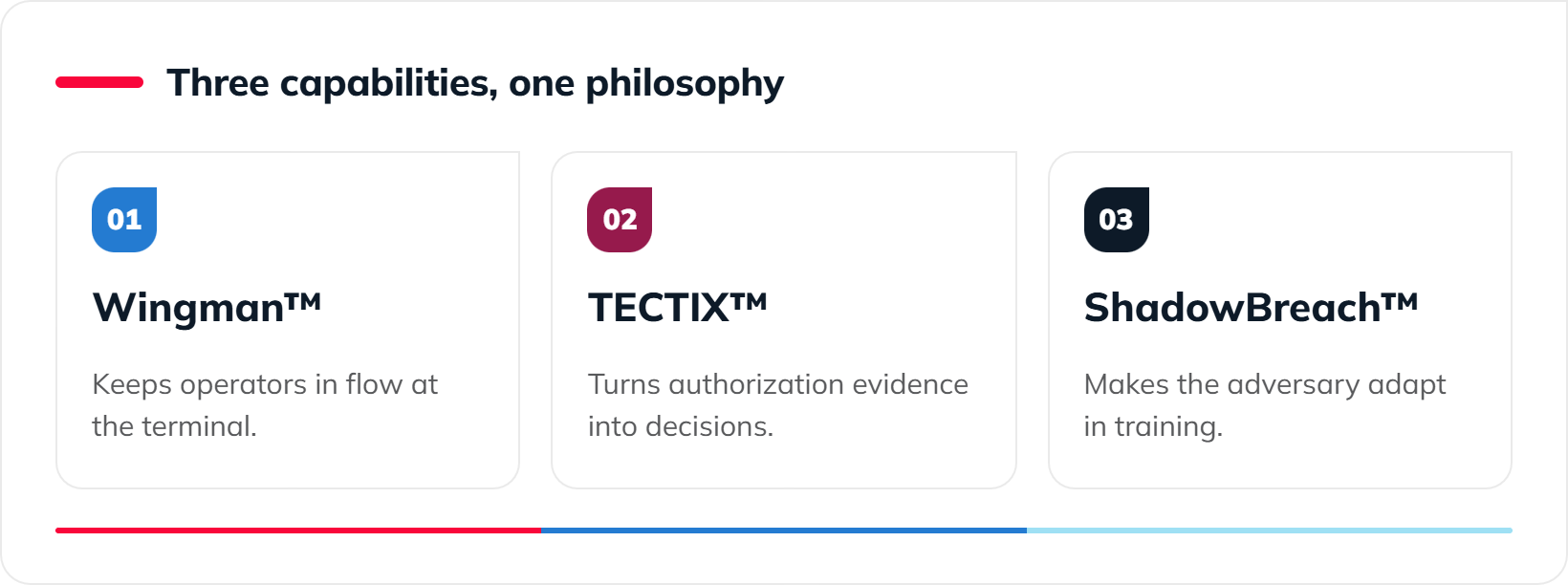
Wingman™
Cyber operators often work across multiple terminals, reference tools, translation services, and documentation at the same time, creating unnecessary operational friction. Wingman reduces that burden by using AI to analyze live terminal activity, retrieve relevant information, translate languages, recommend context-appropriate tools, preserve session context, and generate post-operation reports. The result is faster decision-making, improved situational awareness, and greater operational continuity, helping strengthen mission readiness while keeping experienced cyber professionals firmly in control and enhancing, not replacing, their expertise.
TECTIX™
Maintaining authorization readiness across large system portfolios requires significant time spent reviewing RMF evidence, identifying compliance gaps, and tracking evolving security requirements. TECTIX streamlines that effort through AI-enabled analysis and automation that maps artifacts to security controls, identifies missing or outdated evidence, monitors vulnerabilities and POA&M activity, and surfaces emerging authorization blockers before they affect mission timelines. By delivering timely, decision-ready risk insights, TECTIX accelerates ATO preparation, strengthens continuous monitoring, and enables cybersecurity professionals and leaders to focus on risk evaluation and remediation instead of repetitive administrative reviews.
Download the TECTIX Product Slick Sheet to learn how TECTIX transforms RMF compliance from a resource-intensive burden into a strategic advantage.
ShadowBreach™
Modern adversaries continuously adapt their tactics, while many cyber exercises remain static and predictable. ShadowBreach closes that gap by using AI-enabled adversary emulation to sustain realistic cyber campaigns, adapt tactics in response to defensive actions, and uncover security gaps that scripted training scenarios can overlook.
This creates a more dynamic training environment that strengthens mission readiness, improves response speed, and provides experienced cyber professionals with more opportunities to refine their threat-hunting, detection, and incident-response skills. AI serves as a force multiplier, augmenting human judgment and expertise rather than replacing it.
You may also be interested in: Why Adversary Emulation Must Drive Defensive Change
Bringing It All Together
While each capability addresses a different operational challenge, they share the same design philosophy: AI should strengthen the people performing the mission, not replace them. By combining advanced technology with experienced professionals, Markon helps organizations improve mission readiness, reduce operational risk, and make better-informed decisions in increasingly complex environments.
Ready to see how AI-enabled capabilities can strengthen your organization's cybersecurity posture? Explore Markon's full-spectrum cyber capabilities and discover how we help clients improve mission readiness, strengthen operational resilience, and navigate evolving cyber challenges with confidence.
Explore Markon’s full-spectrum cyber capabilities >>
