
Why Agency Leaders Can No Longer Afford to Think About Security in Silos
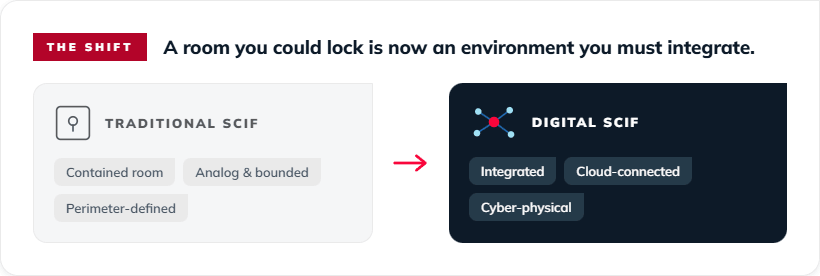
For decades, the Sensitive Compartmented Information Facility (SCIF) was the gold standard for classified operations security, a hardened physical space where sensitive work happened behind locked doors and controlled access points. That model worked when classified work was contained and analog. It no longer does.
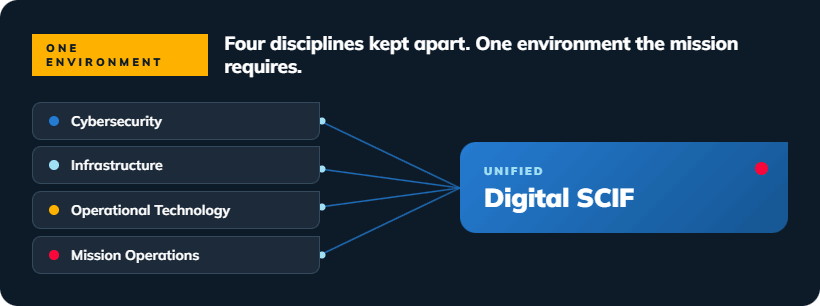
The challenge facing agencies today is no longer simply securing a room. It’s integrating cybersecurity, infrastructure, operational technology, and mission operations into a unified environment capable of withstanding threats that move simultaneously across digital and physical domains. The concept of the Digital SCIF makes that possible, and for agency leaders who haven't internalized this shift, the cost of delay is growing.
The Perimeter No Longer Holds
Traditional SCIFs were built for a world where primary threats came from outside a defined physical perimeter. That world is gone. Intelligence analysts now depend on cloud-hosted data environments and cross-domain collaboration tools. Mission operators rely on AI-enabled analytics. Building systems, such as HVAC, access control, and power management, are increasingly networked and automated. Each connection that improves operational effectiveness also introduces a potential vulnerability.
The result: a cyber intrusion can now cascade into physical consequences, and a compromised building automation system can undermine a classified operation. Treating these as separate security domains is not just outdated, it is operationally dangerous.
This is an Organizational Problem, not a Technology Problem
Agency leaders sometimes approach Digital SCIF modernization as an IT procurement question. That framing misses the point. This is fundamentally an organizational and architectural decision, one that requires agencies to determine how physical security, cybersecurity, operational technology, and mission systems relate to one another and who owns the intersections.
In most agencies today, those disciplines sit in separate offices, operate under separate compliance frameworks, and report through separate chains of command. That structural separation is exactly the vulnerability adversaries exploit. A unified architecture forces the integration that they are counting on agencies to avoid.
The gap is easy to miss because each program can look healthy in isolation. A facility meets its physical security requirements. An IT environment satisfies its cybersecurity mandates. An OT system functions as designed. But if those systems are not planned and operated as an integrated environment, the agency still faces mission disruption the moment a threat moves across the boundaries between them, which is precisely how sophisticated adversaries operate.
What Agency Leaders Should Be Asking
If you are responsible for classified operations or secure facility management, these are the questions worth pressing now:
- Are our physical security and cybersecurity teams working from a shared threat model?
- Do we have visibility into the cyber risk introduced by our building systems and OT infrastructure?
- How would a cyber intrusion in one domain affect mission continuity in another?
- Does our current SCIF architecture support AI-enabled, cloud-connected operations, or constrain them?
These are not technology questions. They are mission and leadership questions, and Markon helps agencies work through exactly these.
How Markon Helps

Markon supports federal agencies across SCIF planning and modernization, cyber-physical security integration, Zero Trust implementation, AT/FP program management, and continuity-of-operations planning.
What distinguishes our approach is coordination across disciplines: we bridge the cybersecurity, infrastructure, OT, and mission operations teams that most agencies keep siloed. That integration is not a capability add-on. It is the core of what a Digital SCIF requires, and the core of what Markon delivers.
The Question Every Agency Now Faces
The convergence of cyber, physical, and operational risk inside classified environments is not a future problem. It is a present one, and it is accelerating. Agencies that treat it as a compliance exercise, meeting individual standards without integrating the systems those standards govern, will find themselves with secure-looking environments that fail under pressure.
The organizations that succeed will be the ones that stop managing security as a collection of separate programs and start managing it as a single operational challenge. For agency leaders, the question is no longer whether this convergence is happening. It is whether your organization is structured to handle it.
