
Most Digital SCIF modernization efforts don't fail because agencies choose the wrong technology. They fail because agencies treat integration as a technical problem when it is fundamentally an organizational one.
Cybersecurity, physical security, operational technology, and mission operations each have their own teams, mandates, and leadership chains. A Digital SCIF requires all of them to operate under a shared architecture and security model. That's the hard part, and it's the part that most modernization plans underestimate.
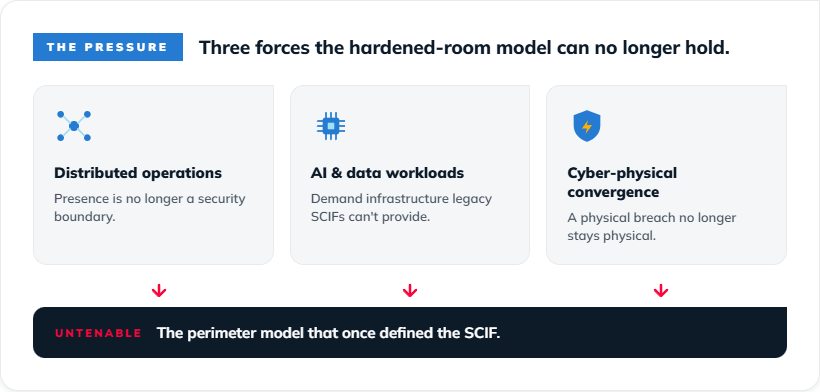
Three Forces Making the Status Quo Untenable
The pressure to modernize is coming from several directions at once, and none of them are letting up.
Distributed operations have made physical presence an inadequate security boundary. Personnel need secure access to classified systems across locations and during disruptions, which means secure connectivity, compartmentalization, and monitoring must extend across the environment, not just within a single hardened room.
AI and data-intensive operations are demanding infrastructure that legacy SCIF environments were never designed to provide. High-performance computing, real-time analytics, and large-scale data processing can't be layered onto traditional architectures without creating operational constraints and technical exposure.
Cyber-physical threat convergence has made the old perimeter model obsolete. Building automation systems, access control platforms, and environmental controls are all networked and all exploitable. A compromise of physical infrastructure no longer stays physical. Agencies that manage cyber and physical security as independent disciplines are maintaining the exact gap that sophisticated adversaries target.
The Challenges That Actually Stop Agencies
The technical requirements for a Digital SCIF are well understood. What stops agencies is the organizational work those requirements demand:
- Legacy infrastructure that lacks the interfaces and patching pathways needed for modern security controls, and that is far more difficult to replace than planning documents suggest
- IT and OT teams with deep expertise in one domain but limited fluency in the other, leaving converged environments under protected
- Organizational silos (e.g., separate leadership, budgets, and accountability structures) that prevent the shared architecture a Digital SCIF requires
- Compliance complexity across ICD standards, NIST frameworks, and Zero Trust directives that must be navigated simultaneously without taking classified systems offline
Agencies that get this right share one characteristic: they build coordination structures that bridge those silos before technical implementation begins, not after.
Markon's Approach to Digital SCIF Modernization
Our role in Digital SCIF modernization is coordination across the disciplines that agencies typically keep separate. We work across cybersecurity teams, infrastructure engineers, OT specialists, mission operators, and government stakeholders–helping agencies build the unified architecture and shared operating model that integrated secure environments require.
For a deeper look at the building blocks of a Digital SCIF and a framework for navigating implementation, download our primer: Inside the Digital SCIF: An Implementation Guide for Federal Agencies
