
On October 1, Japan crossed a line it had approached carefully for decades. Its new active cyber defense regime took effect, giving authorities the power to access and neutralize servers used in serious cyberattacks. For a nation whose postwar security identity was built on restraint, that is a meaningful shift.
It is not an isolated one. Across the Indo-Pacific, governments are moving from passive network defense toward postures that are more active, more collective, and more operational. Policy is moving fast. The harder question for everyone gathering in Honolulu for TechNet Indo-Pacific is whether readiness is keeping pace, because a coalition's cyber capability is only as strong as the operators who have actually practiced working together.
Burden-Sharing Meets Offense
Two U.S. documents released this year set the tone. The 2026 National Defense Strategy makes burden-sharing a core line of effort and states plainly that allied and partner contributions in the Indo-Pacific will be vital to deterring and balancing China. It names intelligence-sharing and operational planning among the priority areas for cooperation.
The March 2026 national cyber strategy adds an offensive edge, committing the United States and its allies to impose real costs on adversaries in cyberspace. Legal analysts expect close partners, including Japan, to see requests for deeper operational coordination.
Burden-sharing is usually debated in budget terms: percentages of GDP, procurement lines, and basing costs. In cyber, the real currency is different. Trained operators who understand each other's networks, authorities, and habits well enough to act together under pressure are the real currency. A coalition can sign an information-sharing agreement in a day. Building the trust to act on that information in minutes takes years of shared repetition.
Read Both Playbooks
Allied strategy documents tell us where partners are headed. The adversary publishes its plans too. As our Senior Cyber Intel Analyst, Bryce Staley, argued in a recent Secure Front analysis, Read the Strategy, Not the Reporting, national plans often signal future cyber targets years before the first indicator of compromise appears.
China's 15th Five-Year Plan, adopted in March and covering 2026 through 2030, is a case in point. AI appears 52 times, up from six in the 2021 plan, alongside semiconductors, quantum computing, 6G, and an ambition to become a "cyber superpower." Priorities like these shape what gets collected, and from whom.
In the Pacific, the pattern is already visible. Volt Typhoon's targets included communications, energy, water, and transportation infrastructure tied to Guam, a linchpin of any U.S. response in a Taiwan contingency. The activity has not slowed. In late August, the FBI, NSA, and Cyber National Mission Force issued a joint advisory on a China-linked group known as QTFY, as the Justice Department announced it had seized a botnet and hacking platform used to target critical infrastructure.
Reading strategy buys defenders time. Training is how they use it.
Allies Are Already Moving
The region's militaries are acting on this. During Balikatan 2026, U.S. and Philippine forces opened their Cyber Defense Exercise to multinational partners for the first time, bringing in participants from Australia, Japan, New Zealand, Canada, and France. Cyber is no longer a side cell in the region's largest exercises. It is becoming a core arena for coalition readiness.
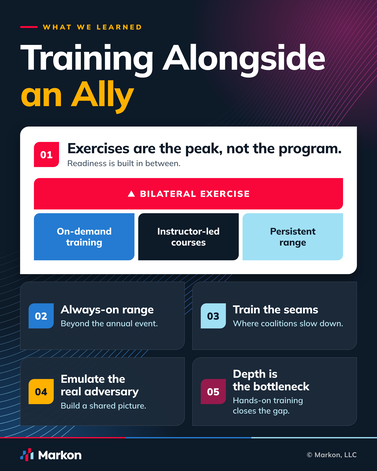 What We Learned Training Alongside an Ally
Our team recently supported a bilateral cyber training effort, with instructors and engineers forward in country serving operators from both nations. A few lessons from that work apply well beyond one partnership.
Exercises are the peak, not the program. Large exercises get the attention, but readiness was built in the months between them. The model that worked rested on three pillars: on-demand training operators could use on their own schedule, recurring instructor-led courses across red and blue skill sets, and a persistent range able to support large bilateral exercises.
Partners want an always-on range. Our partners consistently valued access beyond scheduled exercise cycles. A range that only comes alive for an annual event cannot support the day-to-day bilateral defensive cyber cooperation allies are now asking for.
Train the seams. The hardest problems were rarely technical. Language, classification boundaries, coordination across two defense establishments, and differing legal authorities are where coalitions slow down. With Japan's active cyber defense regime now in force, those authorities are still evolving, and good training puts the seams under pressure on purpose.
Emulate the real adversary. Both nations face the same threat actors. Red teams should run the tactics in current reporting like the QTFY advisory, so partners build a shared picture of what normal and abnormal look like on their networks.
Depth is the bottleneck. Japanese analysts have identified human resources as the biggest obstacle to implementing active cyber defense. Every ally faces some version of that gap, and persistent, hands-on training is the only reliable way to close it.
Decision Superiority Starts Before the Crisis
This year's TechNet IndoPacific theme centers on decision superiority and allied interoperability. Both depend on something no strategy can mandate: operators who have already solved hard problems together. When an incident spans partner networks, the first decisions will reflect the trust built over months of shared reps.
That is the work k>fivefour™ focuses on: operator-built, hands-on training and exercises that prepare U.S. and allied cyber teams to perform under realistic conditions. Interoperability is not built in the moment it is needed. It is built through the shared repetitions, hard problems, and trusted relationships that come before it. If you’ll be at TechNet Indo-Pacific, visit k>fivefour, Powered by Markon, at Booth TB115 from October 26-29 to continue the conversation about persistent training, coalition readiness, and what it takes to prepare cyber teams for the mission ahead.
